
 AI ERP with agents inside the systems you run
 AI phone and voice agents for real calls
 LLM.coPrivate, self-hosted LLM deployments
 Legal AI infrastructure for firms
 AI RFP discovery and response drafting
 Automatic.coBusiness process automation
 CyberAttack.aiThreat detection and defense
 Secure AI virtual data rooms
 DigitalSign.coAI-designed digital signage for any screen
 cstm.aiCustom AI hardware, software, and engineers
AI Has Killed White Label Web Development
For about fifteen years, the white label web shop was a reliable business. A marketing agency sold a $6,000 Wordpress site to a dentist, a plumber, or a Series A startup that needed a landing page. A partner in Lahore or Kyiv built the thing on a template for $900, slapped the agency's logo on the admin login, and everyone got paid. The margin was the business model.
That model is unraveling. Not because of a philosophical shift, but because the unit economics stopped working. A dentist who used to pay $6,000 for a brochure site now prompts Wix Harmony or Lovable for an afternoon and ships something passable for $30 a month. The reseller still charges $6,000. The dentist, increasingly, says no.
This is not a eulogy for every kind of outsourced build. Custom engineering is doing fine. The specific thing that is dying is the resale of commodity marketing sites and small CRUD apps under a middleman's brand. The sooner agency owners and their buyers accept that, the sooner the conversation can move to what still has a margin.
The Resale Model Was Built on an Arbitrage That Just Closed
White label web development was always arbitrage. A domestic agency owned the client relationship; an offshore shop owned the labor cost; the gap paid the mortgage. The product being resold was mostly template assembly, theme customization, a few WooCommerce plugins, and a contact form wired to a Mailchimp list. None of that required senior engineering. It required cheap, reliable hands.
AI website builders have collapsed the floor of that market. The global AI website builder market reached $3.24 billion in 2026, up from $2.69 billion in 2025, and is projected to hit $17.43 billion by 2035 at a 20.55% CAGR. Wix is not sitting still either: in January 2026 it launched Wix Harmony, an AI builder that combines agentic generation, generative design, and vibe coding with manual editing. The buyer who used to need a reseller now gets a prompt box.
The freelance side of the same market tells the same story in sharper numbers. Upwork's Q2 2026 earnings showed active clients fell 4% year-over-year to 763,000 and gross services volume declined 3.6% to $966.4 million, with CEO Hayden Brown pointing to low-complexity assignments being automated faster than expected. The company had already flagged that roughly 10% of gross services volume was particularly exposed to AI automation, concentrated in contracts under $500. Those sub-$500 jobs are exactly the work white label resellers lived on.
AI Builders Have Taken the Bottom of the Market, Not the Top
It matters that the collapse is uneven. A Shopify theme install is gone. A multi-tenant SaaS with role-based access, a billing engine, and a RAG pipeline is not. The dividing line runs through complexity, integration surface, and who owns the risk when the thing breaks at 2 a.m.
The adoption pattern inside Wix itself suggests the ceiling. More than 50% of new Wix users now rely on AI-based setup tools during site creation, and nearly 80% of active Wix sites belong to small businesses or personal creators. These are not Fortune 500 trading platforms. They are gyms, florists, and consultants who used to be the dentist in the opening paragraph. Agency resellers were serving that same slice. The platform now serves it directly.
What the AI builders are visibly bad at is also informative. One review of agency workflows noted that AI output still underperforms on pixel-level spacing and on landmark roles, ARIA labels, and focus management, which are frequently omitted or incorrect in AI output. Core Web Vitals and real accessibility compliance still require someone who reads the HTML. So does multi-tenant data isolation, SOC 2 scope, and anything that touches a payment ledger. That is the work that still bills.
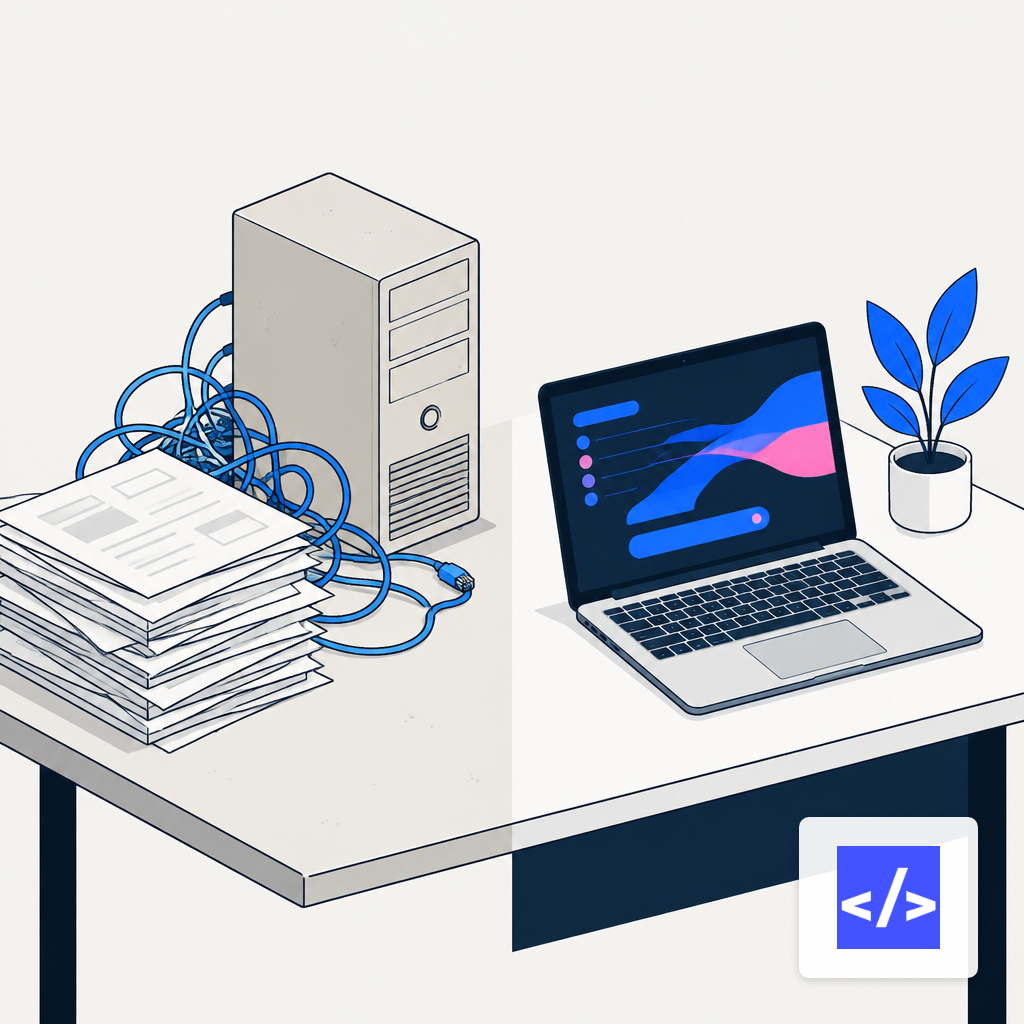
Where Vibe Coding Hits a Wall
Vibe coding, the practice of prompting a model to generate and iterate an entire app, is where the hype gets loudest. The capital agrees: Lovable raised a $330M Series B in December 2025 at a $6.6B valuation, then raised another $400M in August 2026 at a $13.3B valuation, roughly doubling in eight months. On the tooling side, SpaceX agreed to buy Cursor's parent company Anysphere for $60 billion in an all-stock deal in June 2026. These are not quiet numbers.
The developer-productivity evidence is noisier. A Microsoft and Accenture enterprise study of GitHub Copilot showed a 26.08% increase in completed tasks for the Copilot group, with the largest gains among less experienced developers. But a 2026 longitudinal study of 26,317 non-merge commits from NAV IT found no statistically significant changes in commit-based activity for Copilot users after adopting the tool, which suggests perceived productivity and measurable output do not always line up.
Translated into business terms: AI makes a competent engineer meaningfully faster on well-scoped work, and it makes a non-engineer dangerous on anything production-bound. A vibe-coded prototype that passes a demo rarely passes a security review. If your team is shipping AI-generated code, the audit step is not optional, and we have written at length about auditing AI-generated code before it reaches customers.
What Agencies Should Sell Instead
The resale playbook needs a rewrite, not a defense. Reselling a brochure site is a losing trade; reselling judgment is not. A few shifts actually work in 2026:
- Sell the integration layer, not the pages. The site is cheap. The HubSpot-to-Netsuite sync, the custom portal behind the login, and the ingestion pipeline into a RAG index are not. Buyers will pay for a customer portal build because the AI builder cannot touch their ERP.
- Sell AI-assisted development as an engineering service, not a magic trick. A senior team using Copilot and Cursor on a real codebase is not vibe coding; it is AI-assisted development with code review, tests, and an owner. Price the judgment, not the keystrokes.
- Sell modernization off the AI-builder MVP. A founder who shipped on Lovable in a weekend will outgrow it in a quarter. Replatforming off a low-code or AI-generated MVP without a full rewrite is a genuine engagement, and the pattern is covered in our note on replatforming off a low-code MVP.
- Sell regulated, risk-bearing work. Fintech, healthcare, and anything with auditors in the room have never been served well by resale. They need a named architect, a signed statement of work, and code the buyer owns outright.
- 1Audit the MVPInventory the AI-generated code, data model, and third-party dependencies the founder shipped on.
- 2Scope the real productTranslate the demo into a specification: users, roles, integrations, compliance surface.
- 3Design the target architectureChoose the stack, data boundaries, and tenancy model the MVP skipped.
- 4Port the dataMove customers and records off the builder's database into something the client owns.
- 5Rebuild critical pathsReimplement auth, billing, and anything that touches money or PII with tests.
- 6Harden and hand offSecurity review, observability, runbooks, and a named engineer on call.
The Buyer's Side of the Same Shift
For technical founders and product leaders, the implication is cleaner than it is for agencies. If what you need is a marketing site, a landing page, or an unopinionated internal tool, build it on a hosted AI builder and move on. The ROI case for a $6,000 agency invoice on that work no longer closes.
If what you need is a product, a platform, or anything with a real integration surface, the resale shop was never the right vendor anyway. The right vendor is a US-based team with named senior engineers, a defined architecture, and the ability to sit in a room with your compliance officer. That is what distinguishes white label web development for marketing from custom engineering for software that your business runs on.
One useful filter when writing an RFP: if the deliverable can be described as "a website that looks like our brand," you probably do not need a software firm at all. If the deliverable includes words like "pipeline," "tenant," "audit log," "SLA," or "model inference," you do. Our guide to writing a software RFP walks through the specific line items that separate the two.
The Reseller Era Was Always Going to End
White label resale of marketing sites was a business built on information asymmetry: the client did not know how simple the work was, and the agency did not have to explain. AI builders have closed the asymmetry. A gym owner can see, in forty-five minutes, that a five-page site is forty-five minutes of work. The invoice no longer survives the demo.
That is a healthy correction for the parts of the industry that were never engineering in the first place. It changes nothing about the parts that were. Custom software, enterprise modernization, AI systems with real retrieval and real evaluation, mobile apps with native requirements — those still take senior people, real timelines, and a buyer willing to pay for both. The firms that will keep eating are the ones that stopped reselling the easy stuff and started billing for the hard stuff. The dentist can have the AI builder. The bank cannot.
