
 AI ERP with agents inside the systems you run
 AI phone and voice agents for real calls
 LLM.coPrivate, self-hosted LLM deployments
 Legal AI infrastructure for firms
 AI RFP discovery and response drafting
 Automatic.coBusiness process automation
 CyberAttack.aiThreat detection and defense
 Secure AI virtual data rooms
 DigitalSign.coAI-designed digital signage for any screen
 cstm.aiCustom AI hardware, software, and engineers
Why You Should Consider Low-Code or No-Code for Your Custom Software Development Project
Low-code and no-code platforms have lately gotten quite popular in the digital world. They sound pretty alluring, and the prospect of developing software as simple as making a PowerPoint presentation or a Word document seems revolutionary.
With these code development platforms, everyday business users and citizen developers can go ahead and develop projects without having to hire a team of professional developers or large development teams. These platforms are reshaping the application development process, making it faster, more accessible, and less reliant on traditional software development. They also help reduce app development time, empowering organizations to streamline software creation and respond quickly to business needs.
While no-code development platforms don’t require programming, they’re not as ubiquitous as low-code development platforms, which may still require some basic coding skills.
However, they vastly speed up software development by allowing developers to incorporate pre-written code components as well as those managed by AI, machine learning, and robotic process automation.
Low-code development and no-code development can save organizations time and money while offering flexible and scalable ways to create business apps, automate workflows, and support digital transformation. These systems also empower non technical users to innovate, streamline workflows, and create business applications that once required software developers and specialized coding languages.
What Is Low-Code?
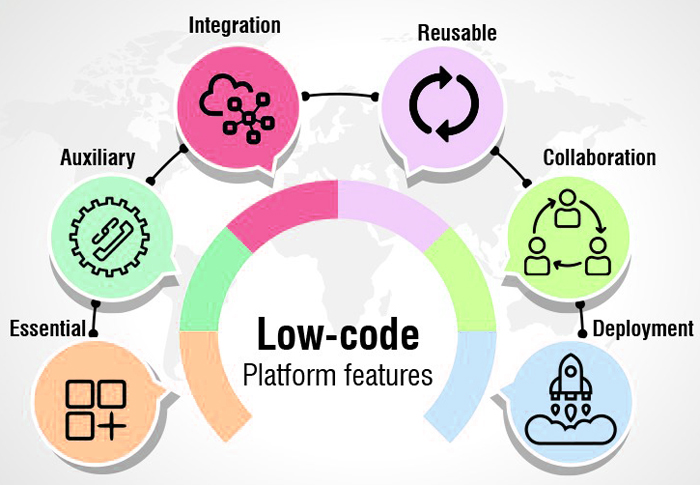
Low-code development platforms make a developer’s job more accessible by allowing them to design applications with a minimum amount of coding.
This software development approach frees them from having to write code line by line; instead, they use visual development tools with drag and drop features to create complex systems more efficiently. With these low code development platforms, developers can create apps and programs by dragging and dropping visual blocks of pre-existing code into a workflow. These tools offer a form of rapid application development, enabling users to build prototypes or fully functional products quickly, and reduce app development time dramatically.
Low-code solutions give you the same results as traditional coding, but with significant efficiency. They enable teams to create applications faster, connect existing apps, and even design custom applications to meet specific business needs.
The critical difference lies in the types of shortcuts offered. Instead of hand-coding a program from scratch, you can go straight to developing something new in much less time, dramatically reducing the overall application development process.
With low-code development, developers can work smarter and faster since they are not distracted by the task of writing endless code line after code line.
Designers and business users also gain more leverage to develop creative solutions since they are not tied down with coding with traditional developers. They also offer additional benefits to developers, business people, and organizations alike, including stronger integration capabilities and improved data management tools.
Using a low code development platform, developers can simultaneously make apps for numerous platforms, particularly when they need to showcase designs to shareholders or clients. Professional developers can also use low code solutions to accelerate innovation and build custom solutions that align with business process objectives.
Professional developers who are acquainted with low-code platforms can even build working designs in a day!
Additionally, If an organization is on a tight budget, low-code platforms can get projects done quickly without incurring the high costs of hiring large development teams.
Low-code development platforms offer excellent integration capabilities, dynamic security processes, easy customization, and cross-platform support — all key features for modern application development which provide a good return on investment and low risk. They are particularly helpful for creating mobile apps or portals that enhance business intelligence and performance visibility.
However, they’re not without their drawbacks. If you lack extensive programming knowledge and don’t have coding experience, you will find it hard to work your way around low-code platforms.
Although these solutions make development easy and offer you many tools, it is necessary to have a basic knowledge of programming languages — you can’t just dive into it.
Also, low-code development platforms do not always promise high-quality results, and your non-functional requirements might not be met using them. For complex systems or complex apps, teams may still need to write code manually to ensure scalability and performance.
What Is No-Code?
Like low-code, no-code development platforms also involve visual development tools and drag-and-drop functionality. However, they are even more straightforward to use.
These code development platforms are designed for business users who have minimal or no programming knowledge but want to create apps or automate repetitive business tasks. They empower non technical users and citizen developers to take part in the software creation process without relying on coding expertise.
No-code solutions are incredibly beneficial for businesses that lack the time or resources to hire software developers or large development teams. They provide a visual way to create applications and manage business process workflows efficiently.
It equips citizen developers with the tools needed to develop programs and apps without needing any formal app development training.
No-code development platforms provide users with tools to build an app or program from the base up, and many budding entrepreneurs use these no-code development platforms to launch e-commerce websites or internal and business applications, much like they would on blogging tools such as WordPress or Shopify.
These solutions resemble popular blogging platforms with prebuilt pages that can launch your website in no time. Let’s look at some of the benefits no-code platforms and solutions offer.
Developers don’t require any special training to use no-code platforms, and they are pretty self-explanatory.
Pretty much any individual with basic computer knowledge or even limited coding experience can work their way around these platforms, which gives users the liberty to move ahead with development without having to divert the IT team from critical projects.
However, no-code also has its disadvantages; for instance, there is no supervision. Just about anyone can develop apps without checks and balances, leading to shadow IT and causing security and compliance issues, problems with data management, integrations, and technical debt.
No-code platforms might give users the confidence to develop projects on their own. Still, it’s worthwhile to take past coding knowledge and programming languages into account before following through with a project.
Low-Code And No-Code Markets
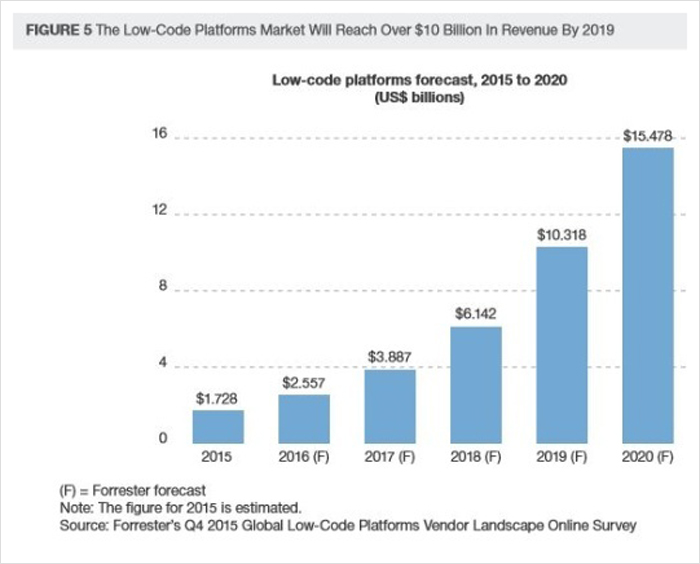
The low code and no code development platforms market is expanding rapidly, catering to different business sizes and industries. These systems are becoming essential for creating business applications, automating business process tasks, and improving app development time efficiency.
There are many low code platforms and no code platforms designed for specific niches — from SMBs and large organizations. These include tools focused on machine learning, analytics, and business intelligence that allow companies to extract more value from their data management ecosystems.
Enterprise-grade low-code platforms often provide better integration with existing systems and legacy systems. However, they are much costlier than other variants.
Most low-code platforms support model-driven application development, where users create diagrams that define processes before turning them into functional applications. This visual method supports low code solutions by helping teams reduce app development time and create custom applications aligned with organizational goals.
This diagram process involves setting up a framework to drag and drop shapes representing sub-processes in the correct order. Most low-code and no-code platforms offer advanced UI capabilities, and they’re well-suited for creating mobile applications.
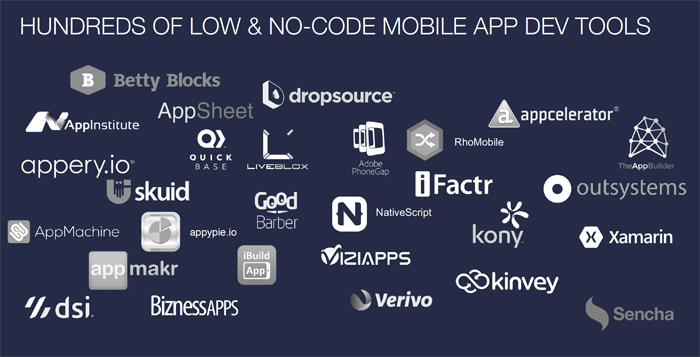
Most low-code and no-code platforms offer advanced UI capabilities, and they’re well-suited for developing mobile applications.
Some platforms even offer support for mobile operating systems like Android and iOS, coming equipped with plug-in collections and customized templates for different applications.
Low-code/no-code platforms cater to an extensive range of niches and target areas, such as e-commerce and online stores like Shopify, work management systems, business intelligence, and even machine learning-driven artificial intelligence.
Many of these platforms (like Bubble.io) and tools have recently diversified into the AI field, C3’s AI Ex Machina being one of the most prominent examples. Such technologies allow software developers and business users to experiment with custom applications that merge automation, analytics, and business intelligence insights.
Low-Code And No-Code Challenges
While low-code development and no-code development are a breath of fresh air for developers and organizations alike, they also present a few challenges, and users must approach them with essential awareness.
Since they are still in their infancy stage, they lack communities, established practices, and a body of experience like traditional coding.
Developers are still unsure about the best practices as the low-code/no-code ecosystem is still relatively fresh.
Firstly, these solutions require a culture change in the IT setup. Most professionals and even organizations are accustomed to traditional programming and development.
Organizations must undergo cultural and operational adjustments to adopt low code development platforms effectively. It requires training business users and citizen developers, rethinking budgets, and adjusting IT governance.
Also, it takes time and effort for businesses to learn and assimilate these platforms within the organization entirely.
Despite being marketed as easy-to-use, these code development platforms still require a certain level of coding knowledge and coding expertise to master advanced functionality such as nested loops or data modeling.
Some features like nested loops are not easy to master. Moreover, some platforms may offer certain advantages over others for particular cases, while others may offer more integration options with enterprise systems.
You might likely need to switch between different tools to get the best components for your apps or custom solutions.
Furthermore, the biggest drawback of these platforms is the lack of community support and available resources.
The lack of strong community support means that unlike traditional developers, users can’t always rely on vast online resources or courses to troubleshoot problems. However, as these platforms mature, we can expect the low code development community to expand, with more resources and best practices emerging.
Traditionally, developers can always find online resources, aids, and courses, as well as communities for outsourcing. Unfortunately, you will find these resources missing in the low-code and no-code ecosystem.
In addition, enterprise low-code and no-code platforms can be pretty expensive. If you opt for smaller and mid-tiered versions, that will be softer on your wallet.
And it could become even more costly if you’re compelled to bounce between iterations of both versions or maintain existing apps while developing custom applications on multiple platforms..
As these solutions become more common, we can expect more challenges to come forth. Right now, these solutions are in their initial phase, and not much is apparent. However, with improved support, smarter automation, and machine learning integration, low code solutions will continue to evolve and enhance business intelligence through better data management.
When To Use Low-Code Vs. No-Code
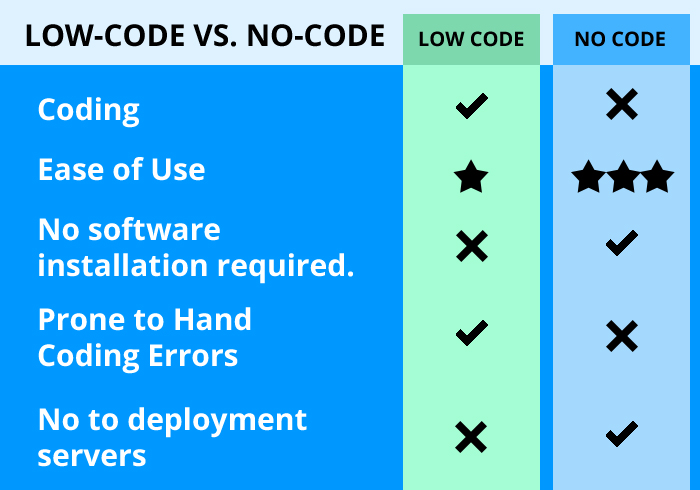
Although low-code and no-code platforms are very similar, they serve different purposes within the application development process.
Both platforms focus on making the development process simpler and faster. But how does one know which platform to use and in which scenarios?
If we were to break down the functionality of the two, low-code platforms would generally be preferred for standalone apps and portals. It supports rapid application development for both mobile and web environments. Also, if you’re looking to develop mobile and web apps or portals that need to be integrated with other systems, low-code is the best option for you.
Generally, low-code is very extensive and can be used for many programs, apps, and portals, besides mission-critical systems that need integration with multiple external data sources.
Developers with basic code or basic coding skills can use a low code development platform to ensure secure, compliant applications that are still customizable.
On the other hand, no-code platforms are not applicable for backend cases and only work for front-end use.
Although their attraction lies in the fact that they are straightforward and do not require any specific training, they are more restricted in their functionality.
If you’re looking to develop simple apps and don’t need any customization, no-code will suit you better. In any other scenario, low-code is the right choice for you, allowing you to build user-friendly, custom applications.
They’re also relatively easy to get the hang of, helping you save time compared to traditional programming.
Both low-code and no-code platforms are suitable for creating business apps aimed at operational efficiencies and legacy systems, such as computerizing manual processes or incorporating business processes and management procedures.
They’re key enablers of digital transformation, allowing organizations to utilize them to modernize their existing apps, bringing their interface up to the cloud, integrating business intelligence, and accelerating app development time, incorporating new technologies like IoT and AI, and transforming their digital framework.
They can also create business apps meant to be used as customer engagement platforms by workers or between business partners and shareholders.
Having said that, the solitary shortcoming of these platforms is that they can only create applications that feature no complex programming requirements or customization. These tools are still best suited for version-1 apps or departmental use cases. When applications evolve into version 2 or 3, they may demand custom code and more complex configurations that go beyond what low-code or no-code can deliver.
Are Low-Code and No-Code the Future?
Expect to see low-code and no-code tools playing an ever-increasing role in app development.
Analysts predict that by the end of this decade, over half of medium to large enterprises will use these tools as part of their application development process.
Even if these platforms do not entirely replace traditional coding, they will account for a large percentage of the total number of app development projects.
For a closer look at how teams actually take a low-code build from a rough prototype to a production-ready release, see our guide on moving from prototype to production with low-code.
As organizations are moving towards remote operations, these platforms allow organizations to empower internal citizen developers and business users to automate workflows and improve productivity—platforms like n8n are a good example of this shift toward accessible workflow automation.
Low code development and no code development tools also democratize the application development landscape, letting smaller organizations compete with larger ones by leveraging the same efficiency gains once reserved for major IT budgets.
And these sources arm companies to jump into development without having to hire new recruits.
Also, no-code and low-code tools seem to equalize the playing field, allowing smaller organizations to keep up with large companies with access to highly qualified experts.
Smaller organizations can utilize their existing resources better and develop apps indigenously with ease, thanks to such tools.
Still, it’s important to note that low-code and no-code are not a total replacement for traditional developers, our take on the future of coding digs into how developer roles are shifting rather than disappearing.
They’re excellent tools for prototyping mobile or departmental version-1 apps, rapid application development, and repetitive business tasks, but when it comes to making changes and updating to version 2, 3, or higher, they fall short.
Furthermore, these platforms are not suitable for enterprise-wide deployment, and they can accrue technical debt while contributing to backlogs.
Therefore, it’s a good idea to choose a platform that can combine the user-friendliness and visual appeal of low-code development with the productivity, integration, and customization of traditional programming languages.
The ideal platform should allow you to reduce app development time, create applications faster, and support scalability without security or compliance issues.
As of now, numerous software vendors provide both low-code and no-code platforms, and some of these platforms even run on the cloud.
In the future, we can expect to see many custom no-code dashboards and platforms that cater more towards enterprise adoption, offering faster development and customization.
However, do not expect low-code platforms to replace traditional programming and development methods completely.
Low-code solutions will continue to fill new niches, such as reengineering technology stacks and ecosystems. Professional developers and software developers have started incorporating them in development to assist them in monotonous tasks that require them to write code repeatedly.
But they haven’t begun to depend on these processes completely.
The areas where low-code platforms were most extensively used were business process or workflow apps, business intelligence dashboards, customer engagement apps, and mobile front-ends.
Their scope is now expanding and filling new niches, such as employee contract tracing apps.
However, we can expect enterprises to stick to traditional programming and app development since they require extensive functionality, data management, customizations to specific environments, and strict compliance regulations.