
 AI ERP with agents inside the systems you run
 AI phone and voice agents for real calls
 LLM.coPrivate, self-hosted LLM deployments
 Legal AI infrastructure for firms
 AI RFP discovery and response drafting
 Automatic.coBusiness process automation
 CyberAttack.aiThreat detection and defense
 Secure AI virtual data rooms
 DigitalSign.coAI-designed digital signage for any screen
 cstm.aiCustom AI hardware, software, and engineers
AI Software Development ROI Statistics for 2026 Buyers
Most AI coding ROI pitches assume a single number: developers go some percent faster, multiply by salary, book the savings. The 2025 and 2026 evidence does not behave that way. Adoption is near-universal, but the measured productivity gain is small, task-dependent, and partially cancelled by review time, rework, and security remediation. For a buyer sizing a $500K build, that is the difference between a project that pays back in six months and one that quietly adds a maintenance tax for three years.
This piece pulls together the figures from DORA, METR, GitClear, Veracode, Stanford HAI, and McKinsey, runs them against a worked example, and names the places where a senior-engineer partner changes the math. The through-line of the research is unflattering: AI amplifies whatever discipline a team already has, and the headline gains shrink or invert once total cost of ownership is counted.
Adoption Is Universal, Gains Are Not
Start with the floor. In Google Cloud's 2025 DORA survey of nearly 5,000 professionals, AI adoption among developers reached 90%, up 14 points from the prior year. The median user spends about two hours a day working with AI and reaches for it on roughly half the problems they hit. That part is settled.
What the gain actually is depends on who measured, what they measured, and on what kind of code. The Stanford AI Index's enterprise data is the sobering baseline: 41% of organizations using AI in software engineering report cost savings, but most of those savings come in at under 10%. McKinsey's task-level work puts routine coding time savings near 46% and high-complexity work under 10%. METR's randomized controlled trial on experienced open-source developers found the opposite of the hype in early 2025: with AI allowed, tasks took 19% longer, while the same developers reported feeling 20% faster. The 2026 follow-up points toward a speedup, but METR itself calls the data unreliable because developers refused the AI-disallowed control.
Treat the "20% to 30% productivity lift" claim as true in a narrow, greenfield, well-typed slice of work, and false or inverted in the rest. For a buyer, the question is which slice your project actually lives in. More context on where each approach fits is in AI-assisted vs. traditional development.
What AI Actually Changes About Delivery Economics
DORA's 2025 finding worth burning into a slide: AI adoption correlates positively with software delivery throughput and negatively with stability. Teams ship more, and they break more. Change failure rate, rework, and mean time to restore all move the wrong way. That is not a tooling problem; it is a review and verification problem that AI amplifies at the volumes it now generates.
GitClear's longitudinal analysis of 211 million lines of change puts numbers on the drag. The share of "moved" (refactored) lines dropped from 24.1% in 2020 to 9.5% in 2024, and code churn within two weeks of commit roughly doubled from the pre-AI baseline. Duplication rose. Fewer problems get consolidated; more get copy-pasted. The code works today and is more expensive to change next quarter.
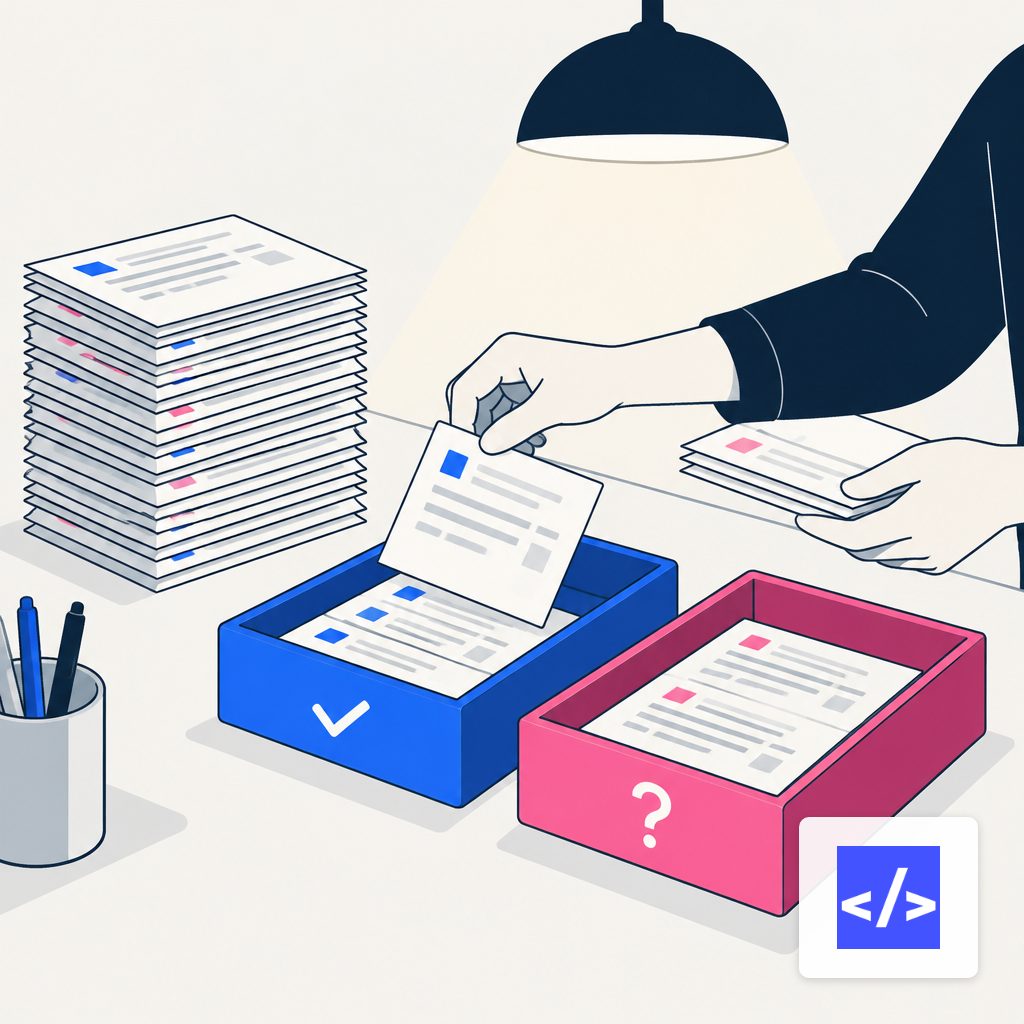
Security is the other line item buyers underweight. Veracode's 2025 GenAI Code Security Report tested over 100 LLMs on 80 standardized tasks and found that 45% of AI-generated code introduces an OWASP vulnerability, with Java failure rates above 70%. CodeRabbit's comparison of AI-co-authored to human-only pull requests found AI PRs produce roughly 1.7x more total issues and 2.74x more security-specific issues. Review cost is not an edge case; it is the median case.
A Worked ROI on a $500K Build
Model a mid-sized custom application: twelve-month build, blended rate of $150 per hour, roughly 3,300 engineering hours, $500,000 fully loaded. Assume the team uses modern AI tooling throughout. Three scenarios, same scope, same team, different accounting discipline.
- Headline-only accounting. Credit the 30% productivity claim at face value. Project comes in at $350,000. This is the number vendors quote in a pitch.
- Realistic accounting. Apply Stanford's post-rework net of 15% to 20% on mixed greenfield and brownfield work. Add review and remediation at roughly 10% of generated-code hours to deal with the Veracode and CodeRabbit defect rates. Net savings land near 8% to 12%, or about $40,000 to $60,000 on the build.
- Brownfield-heavy accounting. On a legacy modernization with complex integrations, apply McKinsey's under-10% figure for complex work and add the churn tax from GitClear. Net savings approach zero on the build itself, and total cost of ownership rises over three years because of duplication and reduced refactoring.
None of these scenarios is wrong in general; one of them is right for your project. The useful discipline is to separate the generation gain from the review, security, and churn costs and account for each line on its own. The same logic applies when scoping a production RAG system or a customer-facing portal, where the hidden costs sit in evaluation harnesses and permission plumbing rather than the model call itself.
Defect Rates, Rework, and the Perception Gap
The METR result is the one engineering leaders should sit with longest. Developers predicted a 24% speedup, experienced a 19% slowdown, and still reported a 20% speedup afterwards. That is a 39-point gap between perception and clock. It means self-reported developer surveys about AI productivity are, on their own, not evidence of ROI. If your vendor's case for AI-assisted delivery rests on how fast the team feels, you are buying a vibe.
Rework is where that gap becomes money. Stanford's 100,000-developer analysis estimates AI generates 30% to 40% more delivered code volume initially, but net productivity after rework lands at 15% to 20% on average, and 0% to 10% on brownfield high-complexity work. GitClear's doubling of two-week churn is the same phenomenon measured on the repo rather than in a survey. The code that gets shipped on Monday gets rewritten by Thursday.
None of this argues against using AI. It argues against pricing a build as if the first-pass generation gain is the net gain. A review-first workflow with senior engineers on every PR is not overhead; it is what prevents the Veracode 45% from reaching production. For context on building a team that treats AI this way, see building an AI development team.
The Hidden Costs Nobody Prices Into the SOW
Four cost lines show up in the data and almost never show up in a vendor's SOW. Each one is small individually and material in combination.
- Review time. DORA 2025 reports instability rising with AI throughput, which translates to more PR cycles, more revert work, and longer time-to-restore. Price review at 10% to 20% of AI-generated hours, not zero.
- Security remediation. Veracode's flat 55% security pass rate across model generations means this is not a problem the next model fixes. Static analysis, dependency review, and secrets scanning belong in the budget from day one.
- Technical debt from reduced refactoring. GitClear's drop from 24.1% to 9.5% refactoring share is a leading indicator of maintenance cost in year two and three. Budget a refactoring sprint per quarter, not per year.
- Lock-in and tooling churn. Model APIs, agent frameworks, and IDE integrations churn on a quarterly cadence. Assume 5% of annual engineering budget for tooling migration, not a one-time setup cost.
These are not reasons to avoid AI-assisted delivery. They are reasons to insist the SOW accounts for them in writing, with named owners and measurement. A vendor who cannot answer "what is your post-generation security review process?" with specifics is quoting the headline number.
Where a US Senior-Engineer Partner Changes the Math
The 2025 to 2026 research points to one consistent conclusion: ROI from AI-assisted development is a function of the surrounding engineering system, not of the model. DORA calls AI an amplifier of existing capability. Stanford's data shows the gain concentrates in low-complexity greenfield work with popular languages. The security and churn research shows the drag concentrates where review discipline is thin.
A US-based senior-engineer partner shifts the math in three concrete places: review coverage on every AI-generated change, architecture decisions kept with humans who own them, and a maintenance posture that treats refactoring as a line item rather than an afterthought. That is the engineering discipline that converts a 30% first-pass generation gain into a durable 15% to 20% net, instead of a 0% net with a defect backlog. More on what that looks like in practice is in why custom AI rollouts belong in-house, and the economics of staffing it is in dedicated team cost.
Benchmarks a 2026 Buyer Should Hold a Vendor To
Numbers worth putting in your RFP or evaluation scorecard, each tied to a 2025 or 2026 source already linked above:
- Measured net productivity after rework, not self-reported speedup. Target 15% to 20% on mixed workloads.
- Change failure rate held at or below the pre-AI baseline, not accepted as a cost of throughput.
- Security pass rate on AI-generated code above the Veracode 55% baseline, verified by SAST in CI.
- Two-week code churn below GitClear's 5.7% to 7.1% industry range, trended monthly.
- Refactoring share of changes above 15%, as a leading indicator of maintainability.
Any vendor pitching AI-powered delivery should be able to show these numbers from a real engagement, not from a marketing deck. A good framework for what else belongs in a buyer's evaluation is in the custom software RFP guide.
- 11. Separate first-pass gain from net gainRequire the vendor to quote generation savings and post-rework savings as two different numbers.
- 22. Classify the work sliceLabel each module greenfield, mixed, or brownfield-complex, and apply the matching productivity assumption.
- 33. Price the four hidden linesAdd review time, security remediation, churn tax, and tooling migration as named SOW line items.
- 44. Set measured benchmarksLock change failure rate, SAST pass rate, two-week churn, and refactoring share into the contract.
- 55. Assign senior-engineer review coverageName the humans who own architecture and PR review on every AI-generated change.
- 66. Re-score quarterlyTrend the benchmarks monthly, review quarterly, and treat refactoring sprints as scheduled, not optional.
What the Numbers Actually Say
AI-assisted development is cheaper than traditional development in a narrow, well-defined slice of work, roughly break-even on mixed enterprise builds once review and security are counted honestly, and more expensive than traditional development on complex brownfield work staffed without senior review. That is not a hedge; it is what the measured data from four independent research programs converges on.
The implication for a 2026 buyer is practical. Scope the project against the slice it actually lives in. Budget the hidden costs in writing. Pick a partner whose economics work when review and refactoring are line items, not footnotes. The savings are real where the discipline is real, and the discipline is what you are paying a senior-engineer team to supply.