
 AI ERP with agents inside the systems you run
 AI phone and voice agents for real calls
 LLM.coPrivate, self-hosted LLM deployments
 Legal AI infrastructure for firms
 AI RFP discovery and response drafting
 Automatic.coBusiness process automation
 CyberAttack.aiThreat detection and defense
 Secure AI virtual data rooms
 DigitalSign.coAI-designed digital signage for any screen
 cstm.aiCustom AI hardware, software, and engineers
How Much Does It Cost to Hire a Dedicated Software Development Team
Most buyers ask what a dedicated development team costs and get a rate card back. The rate card is the least useful document in the negotiation. Two vendors can quote the same $45,000 monthly number and mean completely different things: one includes a tech lead, a QA engineer, and a delivery manager; the other is four mid-level developers and a Slack channel. The number that belongs in your board deck is not the rate. It is the 12-month total cost of ownership against a defensible alternative, with ramp, on-costs, and attrition modeled honestly.
This piece builds that model. It covers pod composition, monthly blended rates by region, the multipliers that make in-house comparisons apples-to-apples, and a 12-month TCO for the three ways buyers actually staff engineering: a dedicated pod, staff augmentation, and full-time hires.
What a Dedicated Pod Actually Contains
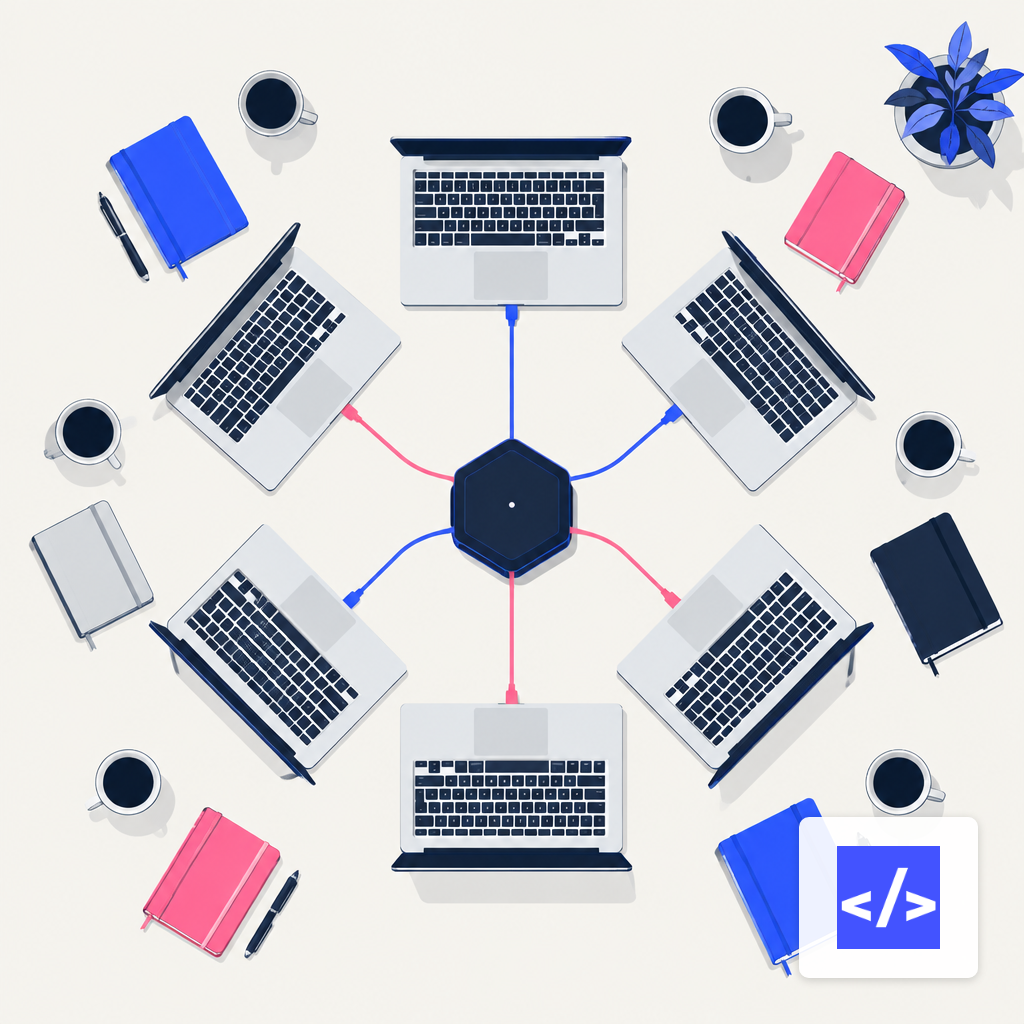
A dedicated pod is not a bag of hours. It is a stable team assigned to your roadmap, managed by a vendor, directed by you. The composition that most vendors converge on for a product-scale build is six people: one tech lead, three engineers (mixed senior and mid-level), one QA engineer, and one delivery lead or PM. Anything smaller starts to look like contractors with a shared calendar; below that headcount the coordination benefit disappears.
The lead sets architecture and reviews code. The engineers ship. QA writes the automation that keeps velocity from decaying in month four. The PM owns sprint mechanics, dependency tracking, and the weekly report that your CFO will read instead of your Jira board. Cut the PM and the tech lead becomes the PM, which means you paid a senior engineer to run standups. Cut QA and rework rate climbs; one industry ledger puts feature rework 3.4 times higher when juniors are placed on mid-level tasks without QA discipline.
If the work involves an API-heavy integration, add a second backend engineer and drop the frontend seat. If it is a mobile build, swap in a platform specialist. The shape flexes; the six-seat floor rarely does.
Monthly Blended Rates by Region
Rates in 2026 sort into four bands, and the spread between them has narrowed at the senior end while widening at the junior end. The figures below are blended monthly rates for a six-person pod in the composition above, sourced from vendor rate cards published this year.
North America onshore runs the highest. Per-developer rates land at $100 to $175 an hour, or roughly $16,000 to $28,000 per developer per month, which puts a full pod between $95,000 and $170,000 monthly. Latin America nearshore lands at $40 to $85 per hour and $30,000 to $55,000 for a five-person team; the six-seat version comes in around $45,000 to $75,000. Central and Eastern Europe overlaps LatAm with slightly better Java and .NET depth. South and Southeast Asia is the floor: $8,000 to $80,000 is the full monthly range across all team sizes, with a six-seat pod typically $18,000 to $35,000.
Two caveats before you paste those numbers into a spreadsheet. Seniority mix moves the number more than geography inside any given region. And AI/ML work carries a real premium: senior AI engineers command 15% to 50% more than general software engineers in every market, with global demand outpacing supply 3.2 to 1. A dedicated AI development pod at nearshore rates lands closer to the low end of onshore pricing, not the low end of nearshore.
The On-Cost Multiplier for In-House Comparisons
The reason vendor pricing and salary offers cannot be compared directly is that salaries are the smallest line in a fully-loaded engineer cost. The Bureau of Labor Statistics reports that wages and salaries account for approximately 69.3% of total compensation in private industry, which means benefits and overhead reliably add another 30 to 45 cents on every salary dollar. Financial planners land on a 1.35x to 1.60x multiplier as the working range for US knowledge workers.
Then add hiring cost. SHRM's benchmarking work puts average cost per hire at $5,475 for non-executive roles in the US, with executive roles at $35,879 and the figure up 21% since 2022. On top of that is time. The engineering-industry median for time-to-hire is 35 to 41 days per role, and the slowest 10% of searches exceed 82 days. Stack five roles and the calendar becomes the risk, not the budget.
Put together, a US senior engineer with a $170,000 base runs $212,000 to $230,000 all-in in year one once benefits, payroll taxes, equipment, overhead, and a recruiting fee are folded in. Multiply by six and the in-house version of your pod carries a $1.27M to $1.38M first-year cost floor before the first commit lands.
Ramp Curves and the First-Month Discount That Isn't
Vendors do not ship at 100% productivity in month one, and neither do full-time hires. For a senior joining a complex codebase, meaningful independent contribution can take two to four months, and existing engineers lose output supporting the onboarding. A realistic ramp curve for a dedicated pod looks like this: 40% output in week one, 65% by week three, 85% by week six, full velocity by week eight to ten. A brand-new in-house hire is slower because they carry benefits enrollment, laptop provisioning, and the compliance training that a vendor already absorbed.
Two operational levers change the ramp. First, documentation. If your architecture decision records, run books, and API contracts are already written, ramp collapses by roughly a third. If they are not, budget the pod's first sprint to producing them. Second, time zone. Sprint velocity drops around 22% when time zones diverge more than eight hours, which is the honest offset against South Asia's rate advantage.
Twelve-Month TCO Across the Three Models
The comparison that matters is total money out the door across a full year, with output held constant. The model below assumes a six-seat pod running for 12 months, US-based product owner, no scope thrash beyond normal roadmap adjustment.
In-house build. Six US hires at $170,000 average base. Fully loaded at 1.4x is $1.43M in salary and benefits. Add six cost-per-hire fees at roughly $5,500 each ($33,000), an average ramp cost of eight weeks per hire at partial productivity, plus attrition insurance. Year-one total: roughly $1.50M to $1.55M, with the caveat that you do not have all six seats filled until month five given a 40-day median time-to-hire per role.
Staff augmentation. Six contractors at nearshore rates of $70/hour, 160 hours a month. Monthly burn is around $67,000, or $804,000 across the year. Add vendor management overhead (one internal PM at 50% loading, roughly $85,000 fully loaded) and light onboarding cost. Year-one total: roughly $900,000. The variable to watch is churn, since augmentation contracts do not carry the retention accountability a dedicated pod does.
Dedicated nearshore pod. Six seats, blended $60,000 monthly, all-in at $720,000 for the year. Vendor absorbs recruiting, benefits, equipment, and backfill for attrition. Internal oversight cost is lower than staff augmentation because the delivery lead is inside the pod, not on your payroll. Year-one total: roughly $760,000.
The gap between in-house and a dedicated nearshore pod is not the whole story. In-house wins on institutional knowledge for a product that will run five to ten years. A dedicated pod wins on the first 18 to 24 months, when the work is heavy, the roadmap volatile, and the cost of a bad hire is a nine-month rewind. Past that horizon, in-house becomes competitive if workload is stable and the product is core to daily operations.
Staff Augmentation Versus Dedicated Team
These two models get conflated in RFPs and they should not. Staff augmentation is a body-shop transaction: you rent hours, you manage the humans, you own the delivery risk. A dedicated team is a delivery unit: the vendor owns velocity, staffing continuity, and the tech lead who wakes up when something breaks. The pricing looks similar in a spreadsheet and diverges in practice.
Pick augmentation when you have a strong internal engineering manager, a clear backlog, and a workload spike that will end. Pick a dedicated pod when you need architecture as well as execution, or when your internal team is too small to absorb the management overhead of coordinating five contractors. If you are writing the requirements document that will decide this, the RFP fields to include are more important than the pricing model itself.
Hidden Line Items Worth Modeling
Three costs rarely make it into the first draft of a comparison and reliably show up by month four.
- Tooling and licensing. Seats for GitHub, CI runners, observability, LLM API budgets for AI-assisted work. Budget $150 to $400 per engineer per month.
- Security and compliance overhead. Background checks, VPN provisioning, SOC 2 scope expansion when a vendor touches production data. Onshore vendors usually price this in; offshore vendors often do not.
- Knowledge transfer at exit. Whether the engagement lasts one year or four, plan for a two-to-four-week wind-down where the pod documents systems and cross-trains any successors. Retainer models that skip this bury the cost in your next engagement.
A pod that comes in 15% under budget with none of the above modeled is not a bargain. It is a variance waiting to hit Q3.
What to Put in the Board Deck
The defensible number is a range with named assumptions, not a single figure. For a standard six-seat product pod in 2026, that range is roughly $720,000 to $1,050,000 for the first year at nearshore rates, $220,000 to $420,000 offshore, and $1.15M to $2.0M onshore. Against a fully-loaded in-house alternative at $1.4M to $1.6M, the nearshore pod pays for itself in month five, and the offshore pod in month two, with the offshore advantage partially clawed back by coordination friction.
The right question is not which number is smallest. It is which model leaves you with a working product, a maintainable codebase, and the internal capacity to run both. For most buyers building custom software in 2026, a dedicated pod is the shortest path to all three; the arithmetic just has to be honest about what it excludes.