
 AI ERP with agents inside the systems you run
 AI phone and voice agents for real calls
 LLM.coPrivate, self-hosted LLM deployments
 Legal AI infrastructure for firms
 AI RFP discovery and response drafting
 Automatic.coBusiness process automation
 CyberAttack.aiThreat detection and defense
 Secure AI virtual data rooms
 DigitalSign.coAI-designed digital signage for any screen
 cstm.aiCustom AI hardware, software, and engineers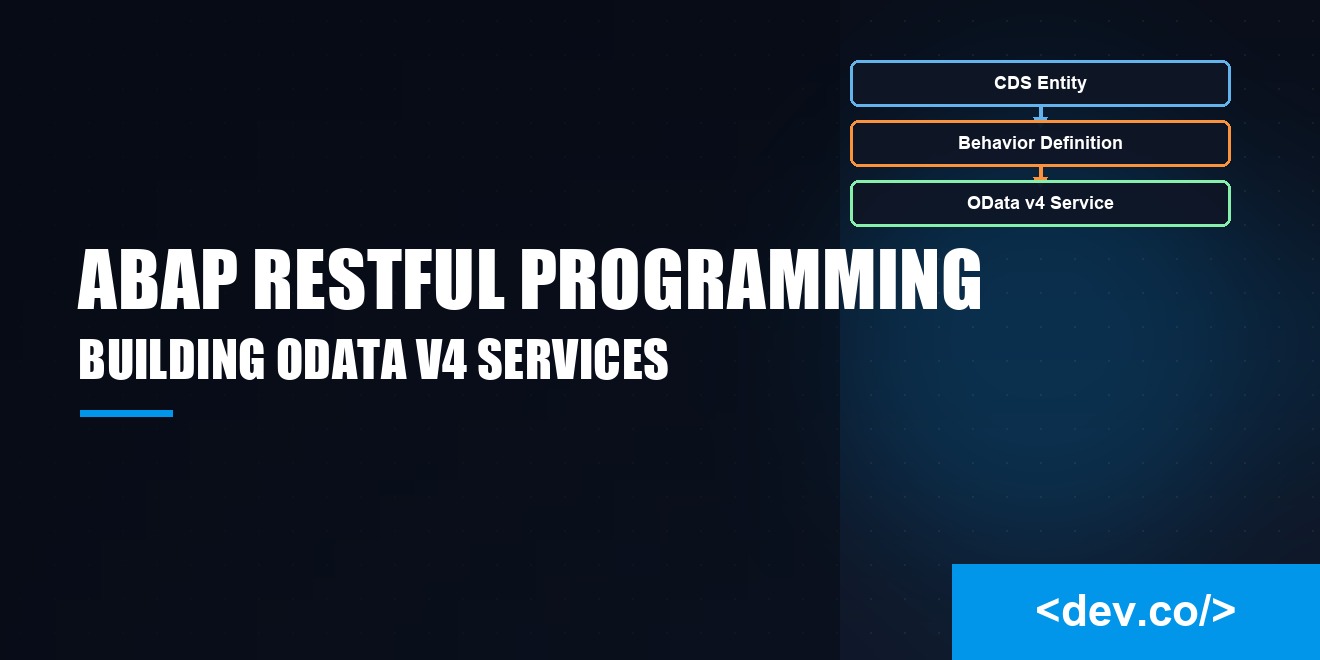
ABAP RESTful Programming Model: Building OData v4 Services
ABAP RESTful Programming Model gives SAP teams a modern way to design, implement, and expose reliable services on S/4HANA. It aligns data modeling, behavior, and API exposure so you can publish clean OData v4 endpoints without wrestling with scattered rules or tangled plumbing.
If your day involves domain logic, authorization, and data integrity, this model keeps those concerns tidy, testable, and calm. In short, it is a practical upgrade for software development that still respects ABAP's strengths.
Modeling Fundamentals
The model separates what your data is from what your data can do. You define structure with Core Data Services, declare rules in a Behavior Definition, then let the framework project a predictable service. This separation lowers mental load and makes change less risky. You can adjust keys, associations, or annotations without reworking the whole stack, or refine rules without pushing them into UI code.
Core Data Services As the Contract
CDS entities capture keys, associations, and calculated elements, enriched with annotations that communicate semantics to tools and runtime. These hints guide exposure, value help, default values, and labels that reach UIs. Consistent names and types become part of a public contract that clients and colleagues can count on. Crisp CDS turns debugging into a quick chore rather than a mystery.
Behavior Definitions As the Brains
Behavior Definitions describe operations, constraints, and lifecycle touchpoints. You specify create, update, delete, plus custom actions and functions that match your vocabulary. You control field mutability, validation timing, and transactional bundling. This layer becomes the rulebook that guards integrity and directs side effects without leaking details into controllers or views.
From Behavior to Implementation
A Behavior Implementation turns the rulebook into ABAP classes that react to lifecycle events. Validations run before anything touches the database. Determinations fill or adjust fields as records move through modify phases. The framework provides buffering, unit of work handling, and late numbering so your code focuses on business logic instead of plumbing. Your methods stay short, readable, and safe to refactor.
Validation and Determination Flow
Validations are bouncers at the door. They check identities, required fields, and invariants. Determinations are ushers that seat defaults, recompute totals, and prepare references. Because the framework orders these steps predictably, side effects remain polite. You also gain a central place for semantic locks and reusable authorization checks that keep concurrency drama low.
Transaction Boundaries You Can Trust
The unit of work groups related changes into a single atomic commit. Either all changes land or none do. Late numbering allocates keys near commit time, which reduces contention and avoids unnecessary inserts. Dependency tracking replaces hand built chains of commits and rollbacks. The outcome is consistency during complex edits and a service that behaves like an adult in production.
Service Exposure with OData v4
After modeling and behavior, exposure becomes straightforward. You write a service definition, create a service binding, and the framework projects entities into OData v4 with correct metadata. Clients discover entities, actions, and functions through the service document, then interact with predictable URLs and HTTP verbs. The surface reflects the model rather than hidden shortcuts, which keeps consumers confident.
Query Options and Payload Shapes
OData v4 gives clients a precise vocabulary. With $select they trim fields. With $expand they traverse associations. With $filter they fetch just the records they need. The framework honors these options while enforcing field control and authorization. Readers see only what they should, writers change only allowed fields, and payloads stay lean for mobile networks.
Actions, Functions, and Side Effects
CRUD rarely covers everything. Actions let a client trigger state changes that match business language. Functions compute values without changing records. Both appear in metadata, which improves discoverability and reduces guesswork in client code. The model also tracks side effects so clients know when to refresh dependent data after an operation.
Draft Handling and Collaboration
Draft handling deserves its praise. A draft is a private working copy that belongs to a user until activation. People can stage edits over minutes without locking active data for everyone else. The framework maintains draft storage, guards concurrent edits, and guides the switch from draft to active with validations. Users keep momentum, and you keep integrity.
Conflict Prevention and Recovery
Optimistic locks and semantic checks prevent quiet overwrites. When two editors collide, the system shows what changed and who touched it. No one loses work, and no one faces opaque errors. Clear messages matter here, since collaboration is where tempers flare if tools get in the way.
Validation During Activation
Activation is a perfect time for heavy checks. You can verify totals, reference integrity, and allowed state transitions. Because drafts contain a snapshot, the system has context to run rules that need a full picture. Errors point to specific fields and offer concrete suggestions so a user fixes the record on the spot.
Authorization, Extensibility, and Upgrades
Security, change readiness, and forward compatibility are built in. The model integrates with SAP authorizations and supports field level control. Extensibility appears in defined exits and metadata, which means additions do not break the core. For versioning, you can publish a new service binding that evolves metadata carefully. Consumers move when they are ready, while old integrations keep working.
Role Design That Mirrors Reality
Map roles to real duties. Analysts might read sensitive fields without editing them. Operators might run actions without seeing fiscal details. With annotations and the behavior layer, you enforce these lines clearly at the API and in generated UIs. Auditors will thank you, and so will your future self.
Staying Compatible Over Time
Additive change is your friend. Introduce nullable fields with defaults. Add new actions rather than repurpose old ones. Keep breaking changes behind new bindings. The combination lets you grow the service without wrecking trust. Version numbers stay calm, and release notes stay short.
Performance and Scalability
Performance is a feature. Start with CDS designs that avoid unnecessary joins and calculated fields that cost too much at read time. Create indices that match common filters. Keep $expand modest, and encourage clients to page through results rather than hauling a warehouse into one response. For heavy work, move long running actions to background jobs and provide a way to check status calmly.
Performance tuning should be thoughtful rather than frantic. Start by measuring how your service behaves under everyday conditions, not just synthetic extremes. Identify the few queries that dominate load and align indices to their filters. Revisit derived fields that force expensive calculations at read time, and consider precomputation where change is rare.
Trim oversized payloads that waste bandwidth, since every unnecessary field invites latency on slow links. When you do optimize, write down why, so future readers understand the tradeoffs you made. Small, patient changes beat heroic rewrites.
Payload Hygiene and Caching
Small responses feel snappy. Encourage clients to request only what they need with $select. Use ETags so caches can verify freshness without hammering the database. Compress responses where it helps, and stream large exports when size makes memory grumpy. These ideas sound simple, and that is exactly why they work.
Concurrency Without Drama
Traffic spikes test designs. Use semantic locks for records that cannot tolerate overlap. Keep transactions short so the database spends time on useful work. Split slow actions into steps that commit progress, then report status back to the user. People forgive waiting when the system is honest and responsive.
Getting Started Without Getting Lost
Begin with a small, credible slice of your domain. Model a few entities, attach behavior, and expose a service binding. Use a client you trust to exercise $select, $expand, and $filter, since that is how consumers live. Each loop adds confidence, and your team starts to think in patterns rather than one off tricks. When reviews focus on rules instead of scaffolding, you know the model is paying off.
Mental Checklists for Everyday Work
Before you release, scan for annotation drift, missing validations, and gaps in authorization. Check that query options let clients fetch what they need in a single round trip. Move logic into the behavior layer if it wandered into the UI. These small habits prevent surprisingly large headaches.
What to Read Next
Official guides cover mechanics with exact steps. Community tutorials provide patterns and lively debates about trade offs. Blend both to form a mental map that survives deadlines. Keep notes on conventions that fit your team so new joiners ramp quickly and your codebase stays coherent.
Conclusion
The ABAP RESTful Programming Model rewards clean thinking and patient craft. Model your data with care, express behavior where it belongs, and let the framework project a dependable OData v4 surface.
Draft handling keeps collaboration friendly, the unit of work keeps transactions honest, and versioned bindings keep consumers calm. Start small, measure reality, and evolve with intention. Your future team will thank you, and your services will feel sturdy, friendly, and ready for real workloads.