AI ERP with agents inside the systems you run
 AI phone and voice agents for real calls
 LLM.coPrivate, self-hosted LLM deployments
 Legal AI infrastructure for firms
 AI RFP discovery and response drafting
 Automatic.coBusiness process automation
 CyberAttack.aiThreat detection and defense
 Secure AI virtual data rooms
 DigitalSign.coAI-designed digital signage for any screen
 cstm.aiCustom AI hardware, software, and engineers
Building AI Into Manufacturing Systems Without Breaking the Line
An OEE report is open on a second monitor, flagging the shift when a vision model started marking more scrap than the inline gauge was catching. The line kept running. The question in the room is whether to leave the model inline, demote it to shadow mode, or roll back the deployment. The answer depends on how the system was built, not on how well the model scored in validation.
AI on a production line is a software engineering problem before it is a modeling problem. The AI in manufacturing market is projected to reach USD 47.88 billion by 2030 at a 46.5% CAGR, but the dollars are chasing a narrow set of use cases that survive contact with an MES, a SCADA network, and a PLC that will not wait on an inference. The rest of this piece is about the integration, latency, and rollback practices that decide whether AI in manufacturing earns its keep or stops the line.
Where AI Earns Its Keep on the Floor
Two use cases carry most of the value today. The first is computer vision defect detection, which augments or replaces inline gauges, cameras tied to vision controllers, and manual inspection. Quality is now the top AI application, with 50% of manufacturers planning to apply AI/ML to product quality. The practical win comes from catching cosmetic and structural defects that fixed thresholds miss, then feeding false-positive and false-negative counts back to a labeling queue so the model learns from the floor.
The second is predictive maintenance software for assets with real failure history: motors, pumps, gearboxes, injection molds. Vibration, temperature, and torque signals from the historian feed models that score remaining useful life. The point is not to retire scheduled PMs. It is to add a layer that flags the specific bearing or screw before it drags OEE down. Deloitte's 2026 survey of more than 140 manufacturers found 84% already generate measurable value from AI, yet only around one in five use cases has been scaled across sites. That shortfall in cross-site scaling is almost always an integration problem, not a model problem.
The Integration Layer That Decides the Project
MES AI integration lives or dies at the seams. A model that predicts yield loss is useless if it cannot read the current work order from the MES, write a hold against a serial, and surface its reasoning in the operator HMI. Real plants connect through OPC UA for live tags, MQTT for sensor streams, and REST or GraphQL into the MES. The historian (PI, Ignition, Aveva) is the system of record for time-series context, and most useful retrieval patterns use pgvector or a dedicated vector store alongside it, not instead of it.
The seams between IT and OT are the hard part. A badly bounded API integration can hang a line when a cloud endpoint goes slow and the PLC's handshake times out. Treat every call that crosses the boundary as if it will fail, with timeouts measured against cycle time, idempotent writes, and queues that drain when the link comes back. OT/IT integration is where senior engineers earn their keep.
Latency, Edge, and the Rollback Discipline
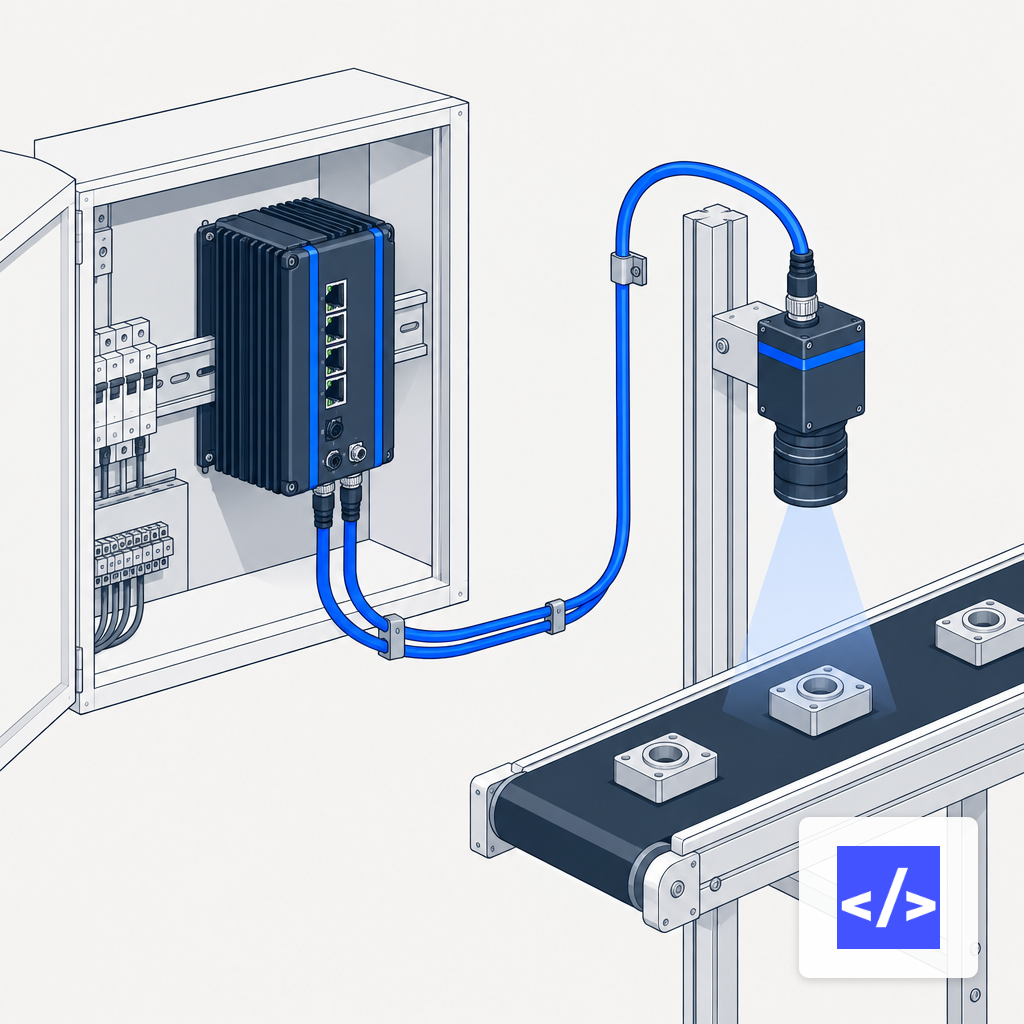
Cloud inference is fine for aggregate reporting and overnight scheduling. It is not fine inside a cycle time of 400 milliseconds. Vision defect detection and in-cycle quality scoring run at the edge, on an industrial PC or a GPU appliance next to the camera, with the cloud reserved for retraining, labeling, and fleet management. This is one of the reasons AI workloads are moving on-prem: the physics of a 24 fps vision pipeline do not care about a hyperscaler's roadmap.
Rollback is the discipline that keeps a line running. Every model gets a shadow mode where it scores alongside the incumbent inspector without acting. Promotion is gated on a documented acceptance window: scrap rate within a bound, false-reject rate below a threshold, latency inside the cycle budget. Models ship as versioned artifacts behind a flag, so the control room can demote a model with one command and the inline gauge takes over. If you cannot roll back in under a minute without a maintenance window, the deployment is not ready for the floor.
OT/IT Security and the Trust Boundary
Any AI integration adds attack surface, and manufacturing is already the most-attacked sector. IBM's 2026 X-Force index attributes 27.7% of cybersecurity incidents in 2025 to manufacturing, the fifth consecutive year the sector has held the top spot. Models that write to the MES or trigger PLC changes are a bigger target than the dashboards they came from.
The baseline is still Purdue-model zone and conduit segmentation, with a DMZ between corporate IT and plant OT, data-diode patterns for historian replication, and signed firmware on inference appliances. Zero trust patterns extend naturally into this stack: service identity for every model, mutual TLS between the inference service and the MES, and short-lived credentials vaulted outside the control network. NIST's draft Cyber AI Profile (IR 8596), released in December 2025 with public comments due by January 30, 2026, is the first federal reference that treats securing AI components, AI-enabled defense, and AI-enabled attacks together. Read it before writing the controls document.
Scaling From Pilot to Fleet
The hardest part of this work is not the first pilot but the second plant. Lighthouse operators like Siemens Nanjing, WEF-recognized for its digital twins and 50+ AI applications, cut lead times 78% versus 2022, lifted productivity 14%, and reduced field failures 46%. The headline is that they did it across a fleet, not in one bay.
Scaling is a staffing and software architecture problem at the same time. The NAM and Deloitte skills gap study projects 2.3 million technician openings across manufacturing and adjacent industries between 2025 and 2030; the plants that scale fastest pair a small central ML platform group with site reliability engineers embedded by region. Standardize the model registry, the labeling pipeline, the deployment manifest, and the security baseline, and let each site own calibration and data drift against local SKUs.
Back to the OEE Report
The OEE report on the second monitor stops being a crisis once the pieces are in place. Shadow mode isolates the vision model while the incumbent gauge keeps running. The versioned artifact rolls back in under a minute when the acceptance window is breached. The MES hold stays with the serial, so the next shift sees the context. The model goes back into the labeling queue, retrains against the flagged frames, and ships again when it clears the gate. AI on the plant floor is not a bet on a single algorithm. Treating it as a disciplined piece of custom AI software is what keeps the line running.