
 AI ERP with agents inside the systems you run
 AI phone and voice agents for real calls
 LLM.coPrivate, self-hosted LLM deployments
 Legal AI infrastructure for firms
 AI RFP discovery and response drafting
 Automatic.coBusiness process automation
 CyberAttack.aiThreat detection and defense
 Secure AI virtual data rooms
 DigitalSign.coAI-designed digital signage for any screen
 cstm.aiCustom AI hardware, software, and engineers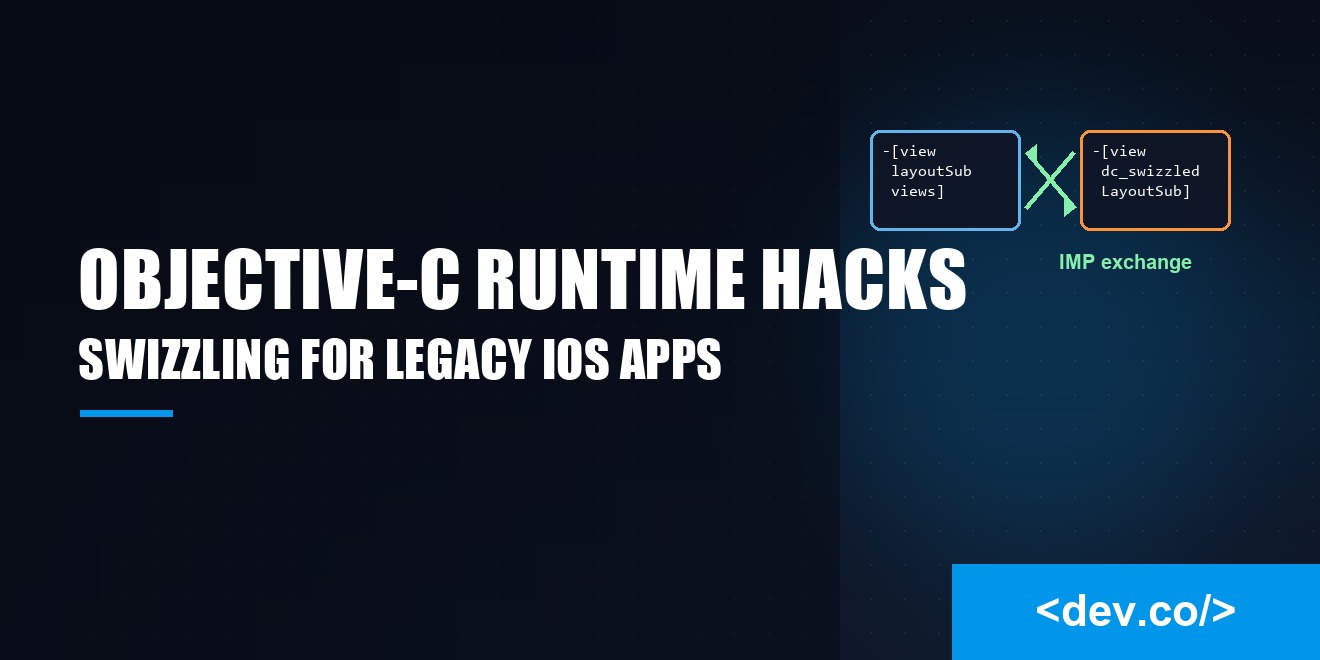
Objective-C Runtime Hacks: Swizzling for Legacy iOS Apps
Keeping a legacy iOS app alive can feel like maintaining a grand old theater while the show never stops. You patch, polish, and hope the lights stay on while scenes roll. In that setting, the Objective-C runtime is your hidden pulley system, and method swizzling is the discreet lever you pull for a fix with minimal disruption.
Used carefully, it lets you redirect behavior, add guardrails, and smooth brittle edges without tearing the set. If your day job sits inside software development, this lever can save the scene without stopping the show.
Why Swizzling Still Matters in Legacy Codebases
What Swizzling Is
Swizzling is the exchange of method implementations at runtime. You identify a selector on a class, prepare a replacement that wraps or adjusts behavior, then swap the two. Calls that used to go to the original now go to your wrapper, which can forward to the original. It is like placing a velvet rope in front of a doorway, checking tickets, then letting guests through as usual. Because the public interface stays intact, you gain leverage without chasing edits across dozens of files.
When It Helps
Swizzling shines when several call sites exhibit the same flaw and you cannot safely modify every caller. Maybe an analytics hook fires twice in distant corners of the app. Maybe a view controller forgets to hop to the main queue before touching the interface.
If you intercept a single hot spot and standardize the behavior, you fix the pattern at the source rather than chasing it across the building. It also helps when a closed source SDK misbehaves and you need a temporary shim while waiting for an upstream fix.
How the Objective-C Runtime Makes It Possible
Messaging and IMPs
Objective-C does not call methods directly. It sends messages that resolve to function pointers called IMPs. Swizzling manipulates those pointers. You fetch the Class, grab the Method for a selector, store the original IMP, and exchange it with your own. Because everything happens through pointers, the compiled code does not change. You are rearranging the control room at startup, not rewriting the script.
Method Resolution and Dispatch
The runtime routes a message by walking the class hierarchy. If it cannot find an implementation, it attempts dynamic resolution and message forwarding. This flexibility is the opening that makes swizzling practical. You perform the exchange during class load or early initialization so that the first message already points to your wrapper.
By keeping a reference to the original, you can call through and preserve semantics while adding checks, logging, or scheduling on the correct thread.
Categories and Associated Objects
Categories give you a place to house the replacement methods without subclassing. Associated objects let you attach storage to an instance for bits of state. Combined, they keep your adjustments tidy. If your wrapper needs a reentrancy lock, a tiny cache, or a timestamp, you can attach it without altering ivars or rebuilding class hierarchies.
Selectors and Type Encodings
Selectors are unique identifiers for method names, and each method also carries a type encoding that describes its arguments and return value. When you exchange implementations, you must ensure the signatures match. If they differ, undefined behavior awaits. The encoding is available from the Method and helps you verify compatibility before touching anything.
Matching signatures also matters for bridging. If Swift calls into your Objective-C code, keeping encodings consistent allows the compiler and runtime to agree on how to marshal values and lifetimes, which keeps your swizzle safe instead of spooky.
Practical Patterns That Earn Their Keep
Auditing Calls and Fixing Quirks
Auditing is a friendly first move. Wrap a suspicious method, capture timing and arguments, then forward. After a few runs in the wild you will see whether the call arrives off the main thread or repeats more than expected. Another pattern is a safety wrapper that enforces contracts. If lifecycle hooks execute on a background queue, the wrapper can hop to the main queue and proceed. No callers change, yet the contract holds.
Feature Flags and Rollback Levers
Pair swizzles with feature flags so you can flip them on for a small audience, watch crash metrics, and roll them back instantly if needed. Together they let you experiment in a high traffic area without committing to a refactor before you have data.
Guardrails That Keep You Out of Trouble
Writing Reversible, Idempotent Swizzles
A reversible swizzle saves the original interface message processor and knows how to restore it. Make it idempotent so repeated initialization does nothing. Use a dispatch once token, prefer exchanging implementations, and verify the selector exists before you touch anything.
Thread Safety and Order of Operations
Perform exchanges before the first call to the targeted selector, usually during class load or an early initialization hook. If you must swap later, guarantee exclusive access. Do not swizzle inside the method you are swapping.
Testing and Observability
Treat swizzles like core production code with tests and measurable signals. A test can call a known method and assert that your wrapper executed by checking a flag or a counter. Lightweight analytics can report that a swizzled path ran and whether it corrected improper states.
Migration Path Toward a Cleaner Future
Bridging to Swift
Many mature apps mix Swift and Objective-C. Swizzling can serve as a bridge while you move responsibilities into explicit abstractions written in Swift. Keep the swizzle at the edges where you cannot change an API. Move the behavior into testable Swift types that you can swap in cleanly later. Over time you can delete the swizzle and call the new abstraction directly.
Extracting Shared Abstractions
Swizzles often reveal missing architecture. If you keep wrapping the same lifecycle hook, extract a small coordinator or service, route behavior through it, and keep the swizzle as a thin adapter until you can remove it.
Common Pitfalls and How to Dodge Them
Swizzling Across OS Versions
Methods evolve across iOS releases. A signature that looked safe in one version can carry new side effects in another. Guard your swaps with availability checks and feature detection rather than brittle version gates when possible. Always test on both your minimum supported version and the latest public release. If a method is private or undefined, consider whether the benefit truly outweighs the risk.
Memory Management Surprises
When you rearrange call graphs, lifetimes and autorelease pools can shift. If your wrapper posts work to another queue, ensure the needed objects survive. Be cautious around dealloc swizzles and keep finalization minimal.
Naming and Documentation
Name swapped methods so intent is obvious in a stack trace. Use a clear prefix and add a short comment with the reason and a ticket. Future you will be grateful.
Final Checklist Before You Ship
Confirm Origination Points
List the selectors you intercept, confirm class ownership, and ensure classes are loaded before exchanges. If lazy loading matters, move the swizzle earlier. Keep the checklist with the code.
Validate Performance
Measure cold start, frame times, and memory before and after enabling a swizzle. If you notice overhead, check for allocations, logging on hot paths, or avoidable queue hops.
That migration path often leads teams toward modern Swift concurrency for the networking layer specifically—see our guide to Swift networking with URLSession and async/await for how async/await and structured concurrency replace the callback-and-completion-handler patterns those legacy apps were built on.
Conclusion
Swizzling is a precise tool for legacy iOS work. Treat it as a temporary scaffold, not a lifestyle. Keep signatures compatible, store and restore the original, and test as if a million users will hit the path in the next five minutes. Document what you changed and why. Then use the breathing room it buys to migrate toward explicit, testable designs that leave the runtime tricks behind when the curtain falls.