
 AI ERP with agents inside the systems you run
 AI phone and voice agents for real calls
 LLM.coPrivate, self-hosted LLM deployments
 Legal AI infrastructure for firms
 AI RFP discovery and response drafting
 Automatic.coBusiness process automation
 CyberAttack.aiThreat detection and defense
 Secure AI virtual data rooms
 DigitalSign.coAI-designed digital signage for any screen
 cstm.aiCustom AI hardware, software, and engineers
How to Replatform Off a Low-Code MVP Without Rewriting Everything
Low-code bought you a market. Now it is costing you one. The founder who shipped a Bubble MVP in six weeks is the same founder staring at a $4,200 workload-unit bill, a 300-second workflow timeout, and a prospect asking for SOC 2 attestation. The question is not whether to leave. It is how to leave without stopping shipping, blowing up the roadmap, or paying a six-figure invoice for a rewrite that lands six months late.
Most of the advice online lives at the extremes: stay forever, or burn it down and rewrite in React and Django. The honest answer is almost always in the middle. Below is the sequencing that actually works, with cost ranges, a decision framework, and the risks that tend to surface in the first 90 days.
Know Which Low-Code Pain You Actually Have
Before you spend a dollar on migration, name the constraint. The replatform decision changes completely depending on which wall you hit.
- Performance ceiling. On Bubble, a sorted search breaks above 50,000 records and workflows fail after 300 seconds. If your p95 page load crossed two seconds and your engineers are rewriting searches to avoid the ceiling, you are already paying rewrite tax inside the platform.
- Cost per seat. Retool's Business plan runs $65 per standard user per month at list price, before external users and AI credits. At 40 internal users, that math stops being clever.
- Compliance and data control. If a prospect wants row-level audit logging, VPC isolation, or a signed BAA, you are usually negotiating up to Enterprise or leaving.
- Product differentiation. If the core thing you sell is the thing the platform does worst — custom math, latency-sensitive flows, bespoke UX — low-code is now holding the roadmap hostage.
- Vendor-lock anxiety. 62% of IT leaders worry about vendor lock-in and nearly 70% of organizations see rising costs within five years of adopting a low-code platform. Common, not fatal, often fixable without a full rewrite.
Each of these points to a different first move. Performance and differentiation push toward strangling the hot path. Cost per seat often resolves with a thin custom portal in front of the same database. Compliance usually forces a full exit, but on a longer runway than founders expect.
Three Paths: Stay, Strangle, Rewrite
There are only three honest replatform strategies. Pick deliberately.
Stay and Harden
Right when the pain is operational, not architectural. Add a dedicated plan, move heavy work into backend workflows, cache aggressively, and put a thin API gateway in front of the platform so you own the public surface. Cost: usually under $25,000 of engineering plus the platform upgrade. Buys you six to twelve months. If the business model is not what the platform does poorly, stay is a defensible answer, not a cop-out.
Strangle Piece by Piece
The default recommendation for most teams that have outgrown low-code. Martin Fowler coined the Strangler Fig pattern in 2004, describing a gradual migration where new code intercepts, redirects, and retires old code one component at a time. AWS prescriptive guidance frames it as the alternative to a big-bang migration done in a single operation, with lower transformation risk. In a low-code context, that means standing up Postgres and a Django or Node service, routing one bounded capability at a time out of Bubble or Retool, and leaving the rest alone until it earns the attention.
Rewrite in One Pass
Rare, and usually only right when the data model is small, the surface area is tiny, or compliance forces a hard cutover date. Rewrites fail at a predictable rate: 83% of enterprise data migration projects either fail or overshoot their budgets. If you are rewriting because the codebase is embarrassing rather than because the business demands it, do not.
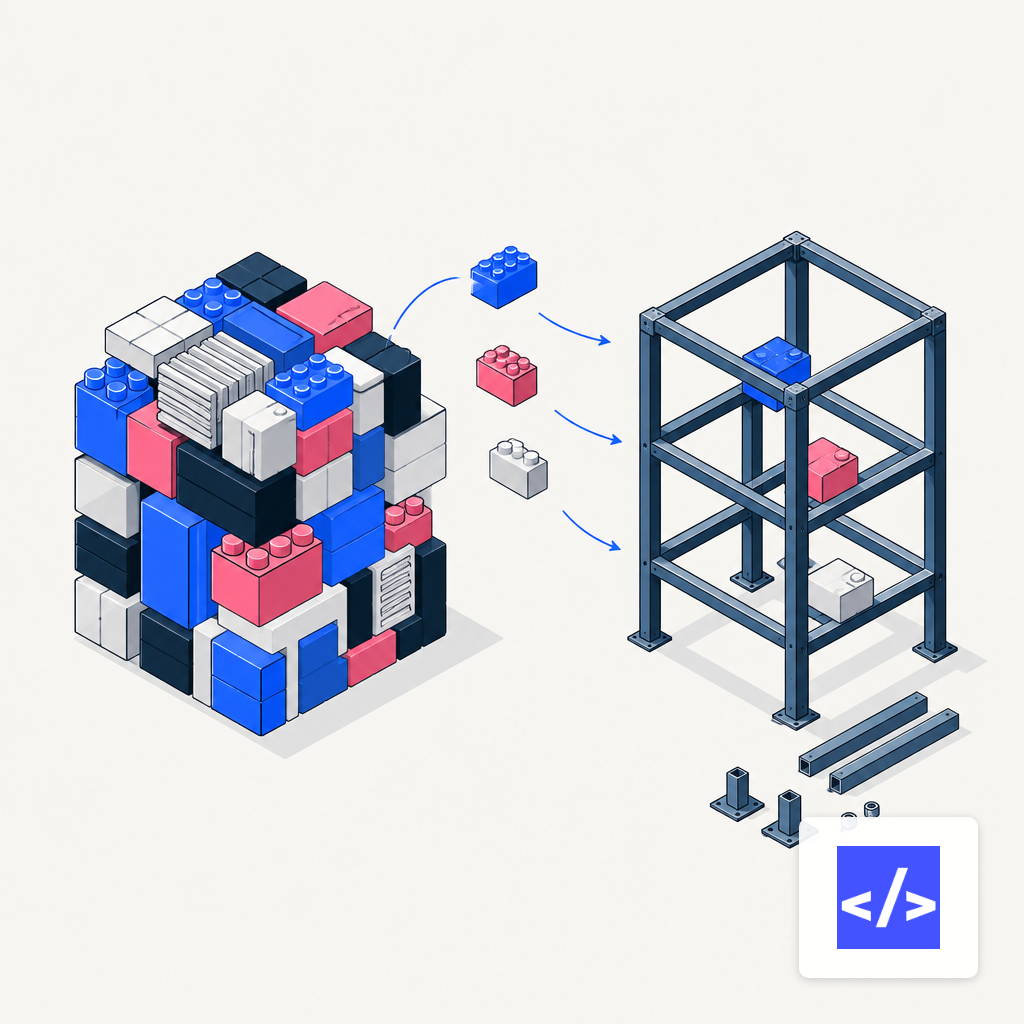
What a Strangler-Fig Migration Looks Like Off Bubble or Retool
Concretely, for a typical Bubble SaaS or Retool-heavy ops stack moving to a React, Django, and Postgres target:
- Mirror the database first. Set up Postgres with the schema you wish you had, then run a one-way sync from Bubble's data API or Retool's underlying database. Normalize what Bubble forced you to denormalize. This is week one through three.
- Put an API gateway in front. A thin Django or FastAPI layer sits between clients and both systems. Reads can hit either side; writes still go to the low-code platform until you cut over.
- Pick the first slice by pain, not purity. The hot path — the one page that times out, the one workflow that costs the most workload units, the one dashboard your enterprise buyer complained about — gets rebuilt in React against the Postgres mirror.
- Route traffic with a feature flag. Five percent, then twenty-five, then the full cutover. Keep Bubble authoritative for everything else.
- Retire the slice on the low-code side. Delete the Bubble workflow or Retool app only after a full billing cycle of clean telemetry. If you need patterns for this, our writeup on PostgreSQL logical replication covers the sync side in more depth.
- Repeat. Each slice ships in two to six weeks. Most teams need six to twelve slices to be meaningfully out.
You never have a code freeze. You never have a "migration weekend." The low-code platform shrinks until it is a thin admin tool or nothing at all.
What It Actually Costs
Numbers vary wildly by complexity, but the public ranges match what agencies see in intake. No-code to custom migrations typically run $50,000 to $250,000 depending on complexity. CIO Dive puts the average enterprise vendor-lock-in migration at about $315,000 once data migration, refactoring, retraining, and downtime are counted. For a strangler-fig exit from Bubble to a React and Django stack, a realistic breakdown looks like this:
A dedicated pod of two senior engineers and a part-time architect will burn roughly $45,000 to $70,000 per month. Twelve to twenty weeks is a common envelope for a full exit on a product with three to five bounded capabilities. If you are evaluating that spend against staffing options, our breakdown of dedicated team cost walks through the real numbers.
The 90-Day Risks That Actually Bite
Most strangler-fig migrations do not fail in month six. They fail in the first ninety days, usually from one of four causes:
- Schema divergence. Two systems, one source of truth. If you let the Bubble UI keep writing fields the Postgres mirror does not know about, you will spend week ten reconciling instead of shipping. Lock the schema contract early.
- Auth drift. Users exist in Bubble's user table and in your new Django auth. Pick one as authoritative on day one, usually the new side, and proxy the old.
- Workflow double-fire. A Bubble backend workflow and a new Celery task both send the invoice email. Idempotency keys on every side-effecting endpoint, not later.
- The "while we're at it" rewrite. The team quietly turns a strangler-fig into a full rewrite because the old data model is ugly. This is how twelve-week projects become nine-month projects.
The last one is the real killer. Twitter had to rewrite key components, moving from Ruby on Rails to JVM and Scala, to solve its early Fail Whale outages. That is a story founders quote to justify ambition. It is also a story about years of rework. Resist the scope creep. Ship the slice.
How to Decide This Month
A reasonable self-assessment, scored honestly, gets you to the right path faster than any consultant pitch.
If performance pain is high, buyer compliance pressure is high, and the differentiating logic lives in the parts the platform does worst, strangle. If it is mostly cost per seat, harden first and build a thin custom portal against the existing data. If you have fewer than ten screens, a trivial data model, and a hard compliance date, a single-pass rewrite can be the right call. Teams that take modernization seriously tend to pull ahead on the numbers that matter: a 2022 McKinsey study of 220 organizations found that companies with the lowest technical debt experienced 20% higher revenue growth than those with the most.
Before anyone writes code, write the RFP. Our guide to what to include in a software development RFP covers the scope language that keeps a strangler-fig honest. The decision you are making is not Bubble versus React. It is sequencing versus heroism. Pick the sequencing.